The Fractured Hour
In the Chamber of Echoes, a time-dilation experiment unravels the mind of an archivist as reality tears open.
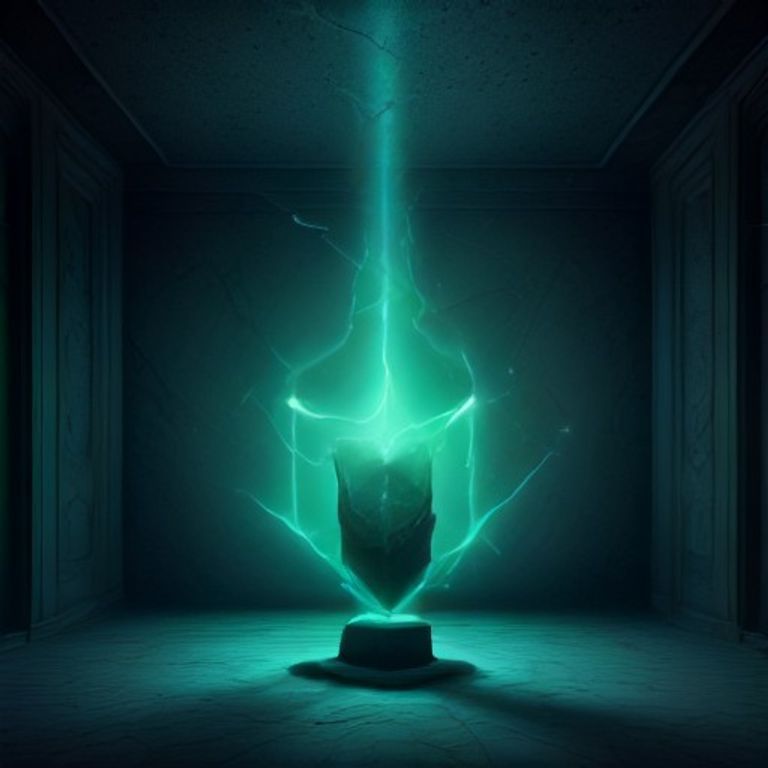
The Chamber of Echoes was a cavernous hall of raw concrete, its walls ribbed with the marks of countless hammers. A single fluorescent tube buzzed overhead, its light stuttering in a rhythm that seemed to sync with the pulse of the moon above. The air carried a faint metallic tang and the dry scent of old paper. Kael, a junior archivist, stood in the center of the room, his hands clasped behind his back, eyes fixed on the bronze altar that dominated the far end. Upon it lay the Book of Enoch, its yellowed pages turning without wind, and beside it a sealed vial of crimson liquid that pulsed faintly, as if breathing.
Baron Malachi entered from the shadows, his charcoal robes brushing the floor with a sound like dry leaves. He did not speak. He simply raised a hand, and the fluorescent light dimmed, then brightened, then dimmed again, each cycle stretching the seconds into a heavy, syrupy flow. Kael felt his own heartbeat slow, not from calm, but from the weight of time itself pressing against his ribs. The room grew colder, and the concrete walls seemed to lean inward, the hammer marks deepening into grooves that resembled faces in agony.
The vial began to release a thin vapor, crimson and iridescent, that curled across the altar like smoke. It carried a sweet, cloying scent that promised oblivion. Kael’s vision blurred at the edges, and the shadows in the corners of the chamber began to move with purpose, coalescing into half‑formed shapes-a child’s handprint on wet concrete, a face pressed against unseen glass, a mouth opening in a silent scream. He tried to look away, but the shapes held his gaze, each one a fragment of a memory that was not his own.
Malachi’s voice, when it came, was a low hum that resonated in the marrow. “You are being reconciled,” he said. “Every thought you hold becomes slower. Every memory stretches into eternity. You will experience eternity before your body finishes dying.” The words were not spoken aloud; they simply existed in the air, as if the room itself exhaled them.
Kael’s breath caught. The fluorescent light flickered violently, and for a fraction of a second the wall behind the altar dissolved, revealing a landscape of endless corridors made of glass that reflected impossible geometries. The sky above those corridors folded upon itself, a violet void that bled light like a wound. The air tasted of iron and static, and a low hum vibrated in his bones. Then the wall was solid again, but the afterimage lingered, a bruise on the retina.
The Book of Enoch’s pages turned faster, the script shifting like smoke. Words formed and reformed, each line a question Kael could not answer. He saw his own name written in a language that predated Aurelia, and beneath it a single phrase: *The Veil is a mirror. You see what you fear.* The realization struck him like a cold wind: the chamber was not a prison but a lens, and his terror was the focus.
A fissure cracked open in the floor near the altar, a thin line of darkness that widened with a sound like tearing fabric. Through it, Kael glimpsed a parallel dimension-a swirling maelstrom of liquid black, its ground a field of skeletal trees with faces frozen in silent screams. The air inside the chamber grew heavier, pressing against his lungs. The crimson mist seeped through the fissure, pooling on the obsidian surface below, hissing as it consumed the concrete.
Seraphina appeared at the threshold, her silhouette framed by the flickering light. Her robes, woven from threads of gold and ash, seemed to absorb the glow around her. She did not step forward; she simply *was*, a presence that bent the light and the air. Her voice was a hymn of static, low and resonant: “The angels are not above us. They are below. In the void between seconds. Between what we name and what we unmake.”
Kael’s eyes rolled back, his vision filled with the inverted reflection of the chamber-walls of barbed wire, floor of broken teeth, ceiling of weeping eyes. The mist rose again, this time forming a perfect, childlike handprint on the concrete. The handprint was not a shape but a presence, a cold, crawling sensation that spread across the floor toward his feet. He tried to move, but his legs were anchored by the weight of unseen centuries.
Malachi’s face remained serene, but the veins on his temples darkened, spreading like ink in water. He reached toward the Book, his fingers brushing the cracked cover. The artifact pulsed, and the fissure in the floor widened, revealing a spiral of star‑fire descending like the core of a dying sun. The spiral hovered, inert, glowing with the sickly green of a bruised sky. “It’s not a weapon,” Malachi murmured, his eyes fixed on the spiral. “It’s a mirror. A memory. And you, my queen, are the ghost in the lens.”
Seraphina’s hand brushed the star‑fire. The spiral dissolved into a chorus of whispers-voices of the dead, the damned, the forgotten. Kael’s breath came in ragged gasps, each one a struggle against the pressure of a reality that was no longer his own. The fluorescent light flickered out. In the darkness, the mist remained, swirling in slow, deliberate patterns, as if waiting for a command that would never come.
The last thing Kael heard was the soft closing of the Book of Enoch, and the understanding that reconciliation was impossible when the past kept reaching forward to meet the future in the middle. The chamber fell silent, the only sound the faint, rhythmic pulse of the vial, beating like a heart that was not his own.