The Gears of Forgetting
A low-level archivist in the Chronos Spire discovers a corrupted ledger that rewrites personal memories, forcing her to confront the fragility of identity as Baron Malachi’s time experiments bleed into the archive’s depths.
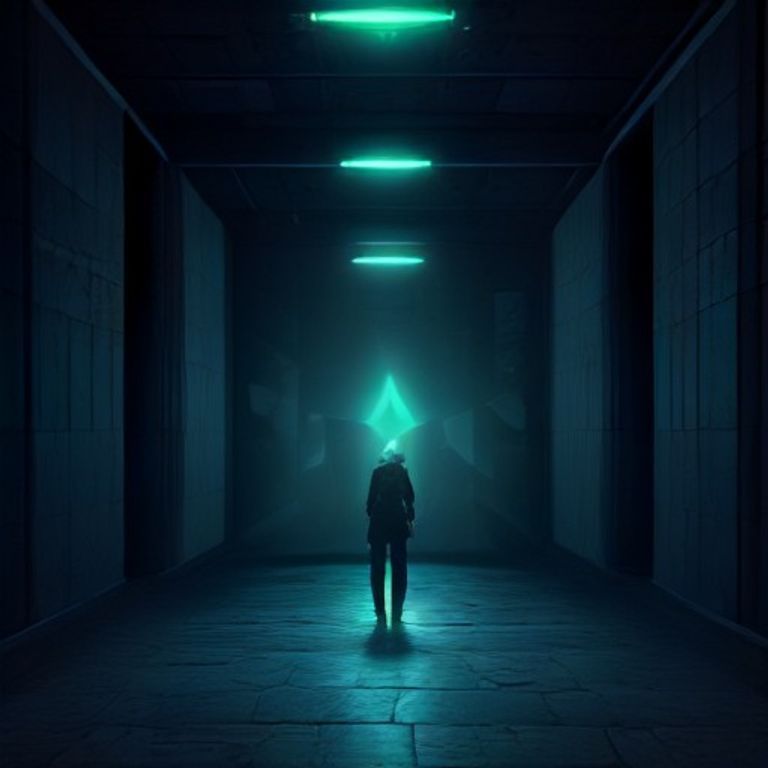
The Gears of Forgetting
The archivist’s boots clicked against the polished basalt floor of the Chronos Spire’s lower archive, a cavernous hall carved from the moon’s bedrock and lined with rows of towering data‑crystals. Each crystal pulsed faintly, storing the whispered testimonies of those who had served Baron Malachi’s regime for generations. The air tasted of ozone and old iron, a constant reminder that the spire was not merely stone but a living conduit for the Book of Enoch’s power.
Lira Vex had been assigned to the archive for three cycles, her duties mundane: cataloguing retrieval requests, verifying the integrity of temporal logs, and ensuring that no unauthorized access corrupted the sacred ledgers. She wore the standard grey jumpsuit of the Chronos bureaucracy, its fabric stiff with the chemical residue that seeped from the lower levels-a residue known to cause bouts of vivid hallucination in those exposed too long. Lira had learned to ignore the occasional flicker of shadow at the edge of her vision, the way the lights sometimes seemed to breathe in slow, uneven rhythms.
On this particular shift, the hum of the spire’s core grew louder, a low vibration that resonated in her molars. She paused at the central console, her fingers hovering over the translucent interface. A request flashed: “Retrieval of Ledger Theta‑9, Sub‑section Echo.” Theta‑9 was an older ledger, one that predated the current dynasty’s consolidation of power. It was said to contain raw accounts of the first experiments with the Book of Enoch, before Malachi had refined the device into a tool of absolute control.
Lira initiated the retrieval. The crystal wall shivered, and a slab of obsidian rose from the floor, its surface etched with shifting glyphs that seemed to rewrite themselves as she watched. She placed her palm on the slab, feeling a faint thrum travel up her arm-a sensation like a heartbeat that was not her own.
The ledger opened, not as a scroll but as a cascade of images and sounds projected into the air. She saw a younger Malachi, his face obscured by a bronze mask, standing before a massive crystal pulsing with violet light. Around him, figures in tattered robes chanted in a language that made her teeth ache. The scene shifted, showing rows of workers in the spire’s lower pits, their eyes vacant, their mouths moving in silent screams. A fine mist drifted from vents above them, a pale green haze that curled like smoke.
Lira’s breath caught. She recognized the mist: the chemical agent used in the lower levels to induce compliance, a substance that frayed the mind’s edges until thoughts became indistinguishable from dreams. The archives had never recorded its use in such detail; the official logs listed only routine maintenance. Yet here, in the forbidden ledger, the truth bled through the crystal’s surface.
She leaned closer, the projection enveloping her senses. The mist seemed to seep into her nostrils, and a sudden vertigo struck her. Time felt thick, each second stretching like taffy. She heard a whisper, not from the ledger but from somewhere deep within the spire’s stone: “You are already forgotten.”
The words were not spoken; they were felt, a pressure behind her eyes that made her skull ache. She tried to pull her hand away, but the slab held fast, its glyphs now forming a new pattern-a spiral that mirrored the shape of the Book of Enoch’s core. Images flashed: Seraphina, the Burning One, seated upon her throne of golden wings, her eyes closed as if listening to a song only she could hear. In the reflection of the throne’s polished surface, Lira saw her own face, but overlaid with layers of other visages-a child with hollow cheeks, an old woman with cracked lips, a soldier whose uniform bore the sigil of Chronos.
Panic rose, not as a roar but as a cold dread that settled in her gut. She realized the ledger was not merely recording history; it was rewriting perception. Each time she viewed a fragment, the chemical haze in the air seemed to intensify, and her own memories began to fray at the edges. She could no longer recall the name of her mother, the taste of her first meal on Aurelia, the exact shade of the sky above the capital city of Solis. All that remained was a vague sense of loss, a hollow where identity should reside.
A sudden clang echoed from the archive’s far end-a service door slamming shut. Lira’s head snapped toward the sound. In the dim corridor, a figure stood silhouetted against the emergency lights: tall, gaunt, wearing the dark coat of a Chronos enforcer. The figure’s head was tilted, as if listening to something beyond the range of hearing.
“Archivist Vex,” the figure said, voice distorted by the ever‑present hum. “You have accessed restricted material. The Book does not tolerate idle curiosity.”
Lira’s throat tightened. She wanted to speak, to deny, to explain that she had merely followed a request, but the words felt alien, as if they belonged to someone else’s mouth. The enforcer stepped forward, and the light from the ledger caught the edge of his badge-a sigil of an hourglass entwined with a serpent.
“You are seeing the truth,” the enforcer continued. “The Baron’s experiments do not merely bend time; they unmake the threads that bind us to ourselves. Those who linger too long in the archive become… echoes. Their memories are repurposed to fuel the device, to keep the rift stable.”
Lira’s vision blurred. The ledger’s projection shifted again, showing a vast chamber beneath the spire where the Book of Enoch rested upon an altar of black crystal. Tendrils of light shot from the book, weaving through the spire’s foundations, connecting to every crystal, every vent, every mind. She realized the spire itself was a massive antenna, broadcasting temporal distortions across Chronos and, perhaps, beyond.
A cold clarity cut through the fog: if she remained, her mind would be consumed, her memories siphoned to sustain Malachi’s grip. If she fled, she would have to leave behind the only life she had known, and the act of leaving might itself trigger a cascade of forgetting, as the chemical haze clung to her clothes and skin.
She wrenched her hand from the slab. The glyphs flared bright, then dimmed as the ledger snapped shut. The enforcer lunged, but Lira slipped sideways, her boots scraping against the basalt. She ran down the corridor, the hum growing louder, the walls seeming to pulse in time with her frantic heartbeat.
Behind her, the enforcer’s voice faded into a low chant, the words of the Book of Enoch echoing in the stone: “Time is a river, and we are its stones.” The chant was not audible; it resonated in her bones, each syllable a pulse that threatened to sync with her own rhythm.
Lira burst into the main atrium, where towering arches of brutalist concrete rose like the ribs of some leviathan. The air here was clearer, the chemical mist thinner, but the sense of being watched was palpable. She glanced up and saw, etched into the highest arch, a faint outline of a winged figure-Seraphina’s golden wings, rendered in negative space, as if the building itself remembered her presence.
She did not stop. She ran toward the service lifts that led to the surface, her mind a jumble of half‑remembered faces and sensations. Each step felt like wading through syrup, each breath a struggle against the weight of forgotten time. As she reached the lift doors, she caught her reflection in the polished metal: her eyes were wide, pupils dilated, but superimposed on her iris was a tiny, spinning gear-an emblem of the Book’s mechanism.
The lift shuddered to life, ascending slowly. Lira pressed her back against the wall, trying to anchor herself with the sensation of cold concrete. The doors opened onto the moon’s barren plateau, where the horizon was a jagged line of basalt under a sky streaked with the faint glow of Aurelia’s distant sun. The wind carried a faint scent of ozone and something sweet, like burnt sugar.
She stepped onto the surface, the low gravity making her movements feel clumsy. She looked back at the spire, its silhouette a monolithic nightmare against the void. For a moment, she thought she saw a figure standing at the spire’s apex-Malachi, mask gleaming, arms outstretched as if conducting an invisible orchestra.
Then the wind shifted, and a whisper brushed her ear, not from the spire but from within her own thoughts: “Remember who you were.” The phrase was both a command and a plea, and it lodged itself in her mind like a shard of ice.
Lira turned away from Chronos and began to walk across the plain, each footfall sending up tiny plumes of dust. She did not know where she was headed, only that she needed to put distance between herself and the archive’s hunger. As she walked, the chemical haze seemed to thin, and with it, the frantic edge of her thoughts softened. Memories flickered-brief, fragmented images of a garden on Aurelia’s capital, of laughter shared with a sibling, of a promise whispered under a twin‑moon sky.
She realized that the terror she felt was not of gore or monsters, but of the slow erosion of self, the creeping certainty that the very thing that made her her could be rewritten by a device she did not comprehend. The dread lay in the uncertainty: if she stopped, would she forget why she had started? If she kept moving, would she ever find a place where her mind was wholly her own?
The horizon swallowed the spire’s silhouette, and the wind carried her footsteps into the endless dark. Lira Vex walked on, a solitary figure in a brutalist cosmos, her mind a fragile ledger she hoped to keep from being rewritten.