The Cartigrapher of Still Waters
A navigator stranded in temporal anomaly must carry a message from the frozen second moon to Queen Mother Seraphina -- a warning that her throne is a door, and she has been sitting on it for six thousand years.
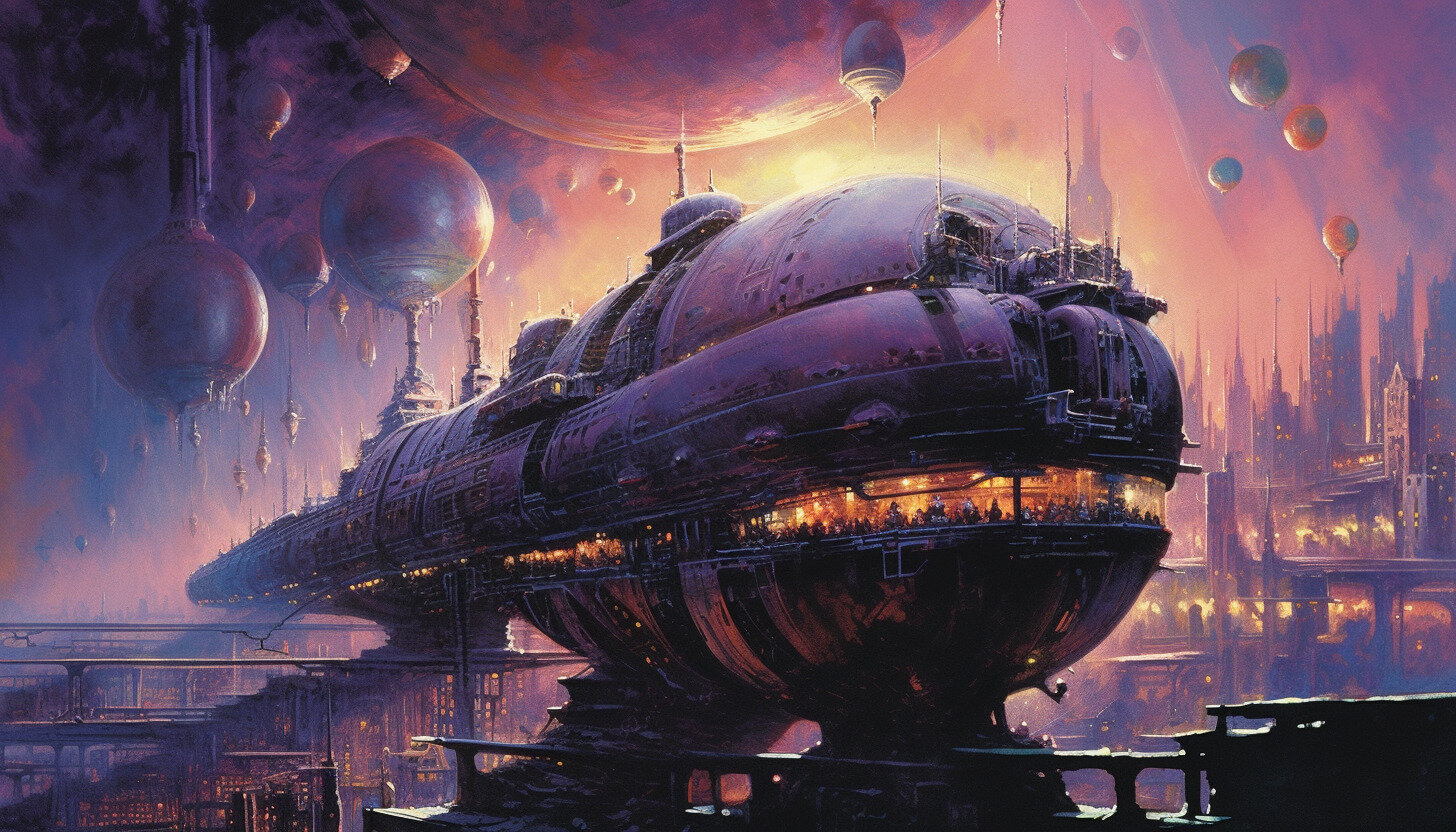
**THE CARTIGRAPHER OF STILL WATERS**
---
The navigator's name was Kira, and she had memorized every lie told about the second moon.
She recited them during the descent, her lips moving beneath the helmet fog of her vacuum suit, words condensation-drunk and soft: *Paradise. Garden. The Still Point. Sanctuary of the Exiles.* The transport's hull groaned as it shed velocity, and through the viewport the surface resolved itself in a palette of wrong colors -- greens that trended toward grey, blues that remembered black, an ocean that had never learned to move.
"That's not water," she murmured.
Beside her, the other passengers did not respond. Six souls aboard a vessel designed for twelve, their bodies slack in acceleration couches, their eyes open and seeing nothing. The medical readout on Kira's wrist had flatlined their neural activity six hours ago, but the automatics had not ejected them because the ship's AI had been programmed by someone who believed that corpses still required legroom.
She was the only one awake. She had been awake for forty-seven days, ever since the *Pale Meridian* had passed through the Veil of Tears at the edge of Chronos's orbit and emerged... elsewhere. Not another place. Another *when*. The timestamps had glitched, then stabilized, then shown a date three months in the past, then three months in the future, then nothing at all.
The second moon had no name on any official chart. The Aurelia hegemony called it nothing, because to name something was to acknowledge it, and the hierarchy could not afford to acknowledge a place that existed outside the Baron's reach. Malachi's power flowed from the Book of Enoch -- time and space, manipulation and control -- and the second moon sat in a pocket of absolute temporal stillness. Nothing changed there. Nothing could.
The transport touched down on a landing field of white sand that was not sand, and Kira walked alone into a city that had been waiting.
---
The architecture was organic.
This was the first wrong thing, the thing that made her skin crawl beneath the vacuum suit's thermoregulation layer. Aurelia's structures were brutalist -- poured concrete, Soviet-colossal monoliths, angles meant to intimidate and endure. But here the buildings grew. They rose from the earth with the patient inevitability of trees, their surfaces smooth and pale as bone, their windows not cut but *formed*, as if the structures had dreamed of eyes and opened them willingly.
No streets. The pathways between buildings curved like arteries, and the ground beneath her boots had a give to it that suggested flesh. She pressed her palm against a wall as she walked, and the wall pressed back -- not warmly, not coldly, but *with attention*, as if the city had noticed her and was deciding what to make of her.
She had been briefed on this before launch, or rather, she had been briefed on what the hegemony *suspected*: that the second moon was a wound in the fabric of Aurelia's reality, a place where dimensional leakage had pooled and stagnated for millennia. The Watchers -- the Witnesses -- the angels that Malachi whispered about in his throne-rooms -- they had not crossed through the Veil of Tears. They had *bled* through, slowly, over generations, and their essence had fertilized this soil.
The buildings were not buildings. They were calcified prayers.
Kira found the square by following the absence of sound. The city hummed at frequencies just below human hearing -- a vibration that meant *alive* -- but here the hum stopped, a bubble of true silence that seemed to absorb her footsteps before they could echo. At the center of the square stood a fountain that had never moved, its basin filled with water so still that it looked solid, a mirror that reflected nothing because there was nothing to reflect.
A figure sat on the fountain's edge.
It was humanoid in the way that a shadow is humanoid -- recognizable shape, recognizable posture, but no substance, no weight. Its features, if they could be called that, shifted when Kira approached: a child's face, then an old woman's, then something in between that was neither and both.
"You are the first to arrive awake," the figure said. Its voice came from everywhere and nowhere, from the water that did not move and the walls that breathed. "The others came dreaming. They are still dreaming. They will dream forever, unless you carry them out."
"I cannot carry six corpses," Kira said. "I can barely carry myself."
"You are not carrying yourself." The figure tilted its head -- a gesture of curiosity that belonged to no human tradition. "You arrived in a vessel that moves through time as though it were water. You are drenched in the Baron's current. He has marked you, navigator. He knows you are here."
The words hit like pressure changes, like the moment before decompression. Kira's hand went to the side of her helmet, where the radio was dead, where no signal could reach her, but still the Baron's name hung in the air between them.
"How does he know?"
"Because nothing happens here without his awareness." The figure rose from the fountain's edge, and its form elongated, stretched, became something vast and sorrowful that blocked out the pale sky. "The Book of Enoch reads this place as its opposite. Its mirror. Its fear. Malachi cannot control the second moon, but he can see it -- and what he sees, he remembers. And what he remembers, he *uses*."
The walls of the city shifted. Not physically -- they did not move -- but their attention turned, their windows focusing, their surfaces rippling with the faintest suggestion of faces that had been pressed into them over centuries of slow growth.
"They are afraid," Kira said, and she did not know if she meant the walls or herself.
"They are patient," the figure replied. "They have waited for someone who could carry a message. Someone whose mind had been touched by time-dilation but not broken by it. Someone who could pass through the Veil of Tears again and arrive not in the past or the future, but in the *present* -- the present that the Baron has been trying to erase for three hundred years."
Kira looked at the fountain. The water stared back, still and absolute.
"What message?"
The figure leaned close, and its breath was the smell of an ocean that had never known wind, of a stillness that had no bottom.
"Tell Seraphina: the throne with three sets of golden wings is not an artifact. It is a *door*. And the Queen Mother has been sitting on a key for six thousand years."
The silence in the square deepened. Kira felt it pressing against her eardrums, against her thoughts, against the thin membrane of sanity that had kept her upright for forty-seven days of waking sleep.
"And if I refuse?"
The figure smiled, and in its smile she saw the faces of everyone who had ever come to the second moon dreaming, their mouths open, their eyes empty, their bodies slowly becoming part of the architecture.
"Then you will sit on the fountain's edge, and you will wait, and you will become what we have become. Not dead. Not alive. Simply *still*. The Baron's antithesis, frozen in the only place he cannot reach."
Kira looked at the water. The water looked at her.
She thought of the *Pale Meridian*, of the six bodies in their acceleration couches, of the dates on the ship's log that could not agree with each other. She thought of Malachi in his temple of bone and crystal, reading time like a book he had written himself. She thought of Seraphina, the Burning One, sitting on a throne that was not a throne, a door that was not a door.
She reached out and touched the water.
It was warm. It was the temperature of blood, of breath, of something that had been alive once and had chosen, for reasons no human could fathom, to stop.
"I'll take your message," she said.
The figure nodded, and its form collapsed inward, becoming a seed, becoming a root, becoming part of the city that grew and grew and would never stop growing.
Kira walked back to the transport. The walls did not press against her palms anymore. They had already decided what she was.
A carrier.
A messenger.
A key that had not yet been turned.
---
The transport lifted off into a sky that was not a sky, and beneath her the second moon continued its patient vigil, its organic spires reaching toward nothing, its stillness absolute.
In the pilot's chair, Kira set a course for Chronos.
For the first time in forty-seven days, she slept.
And in her dreams, she saw three sets of golden wings, unfolding from a throne that had been waiting, and she understood -- too late, perhaps, or perhaps exactly on time -- that some doors do not open from the outside.