Tempora Docent
Investigator Yuri Volkov steps through a door that opened from the outside and discovers the Commissariat of Temporal Affairs was built around something ancient, something that has been waiting - and the chemical haze filling Chronos's corridors is not a weapon but an invitation.
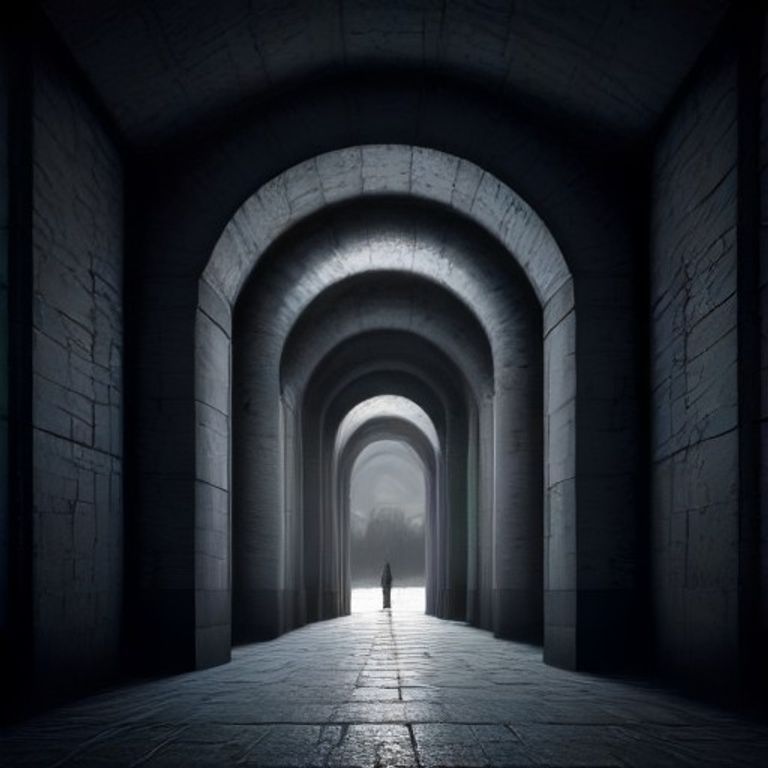
Yuri Volkov stepped through the door that opened from the outside.
He did not choose to. His body moved before his mind gave permission, as if some deeper architecture within him had already committed to the act. The corridor behind him did not collapse. It simply continued, uninterrupted, as though the door had never existed at all - and yet he could feel the cold of the threshold on his palms, the ghost-pressure of a threshold that had been sealed for longer than human presence on Chronos.
He was not in the Commissariat.
He was beneath it.
The space he entered was vast - not in the way that a room can be vast, but in the way that a wound is vast, an absence that has always been there and was only ever hidden. The walls were not concrete. They were the stone the photograph had shown: massive, hand-carved blocks bearing symbols that no Soviet architect had designed and no human tongue had spoken. The carvings moved. Not literally - Yuri would have sworn on his life they moved - but the shadows they cast shifted in patterns that did not correspond to any light source he could identify. The light here was the same flat gray as the Commissariat above, yet it fell from a direction that was not up.
And the arch.
The arch from the photograph rose from the bedrock before him, larger now than the image had suggested, larger than it had any right to be. It was not built. He could see that with his eyes, with the animal certainty that lived in the part of his brain that recognized bones and trees and things that grew. The stone had been coaxed, shaped, persuaded into span - and through its open frame there was nothing. Not darkness. Not light. Not the void that is merely the absence of matter. Something else. Something that the human visual cortex interpreted as nothing and that Yuri's hindbrain recognized as *presence*.
The metallic tang in the air was stronger here. It tasted like pennies and like memory - like the smell of his mother's kitchen, which he had not thought about in twenty years, suddenly flooding his mouth with impossible clarity. The chemical agents seeped through the ventilation system above, but down here they were not agents. They were language. Each breath was a sentence the walls were writing into the soft tissue of his lungs.
Yuri raised the photograph. He had taken it without remembering taking it. In the gray light the image seemed to pulse, the black-and-white tones deepening until the construction workers in the image were no longer men but silhouettes - tall, angular, with proportions that did not belong to any primate he had studied in the Academy's limited zoological archives. And the arch in the photograph was not embedded in the foundation. The foundation was embedded in the arch, as though the stone had grown around something that was already there, that had always been there, that would remain long after the concrete had crumbled to dust.
*Tempora docent.*
Time teaches.
The words appeared in his mind not as thought but as inscription, as if the parchment beneath his fingers was pressing its script into the tissue of his brain. He understood - not with his intellect but with some older faculty, some survival instinct that predated language - that the photograph was not a document. It was a trap. It had been waiting for someone to find it, to study it, to hold it to a light that did not exist. The moment he recognized the arch, the arch recognized him.
The clock on the wall began to tick. There was no clock on the wall. There was no wall. But the sound was unmistakable: the old regime clock from the Commissariat above, ticking backwards, each second a wound reopening, each tick a memory he had not yet lived being pulled backward through his chest. He felt his age divide - the forty-three days of his assignment and the forty-three years of his life before it, and beneath both, deeper, the age of the stone, the age of the arch, the age of whatever had first pressed its hand into the bedrock of Chronos and left the impression that the Book of Enoch would later be bound around.
A voice. Not Malachi's. Not the intercom, not the ductwork, not the radiator. A voice that came from the arch itself, from the nothing within its frame, shaped into sound by the chemical haze that had been filling his lungs for forty-three days.
*The angel was here first.*
He had thought the Baron's note was a warning. It was not. It was an acknowledgment. A receipt. The Baron had not written it. He had transcribed it, the way one transcribes a dictated letter, the way one records a phenomenon that is observed but not understood. The angel - whatever the angel was, whatever it had been waiting in the parallel dimension that the Book of Enoch described not as heaven or hell but as *the place between the ticks of the clock* - had arrived on Chronos before the Soviets. Before the Baron. Before the moon had been hollowed out and filled with machinery and men.
And it had been waiting for something.
Yuri understood now, with a clarity that felt like amputation, why Seraphina had requested a second audience. She was not bringing intelligence about the Luna-3 facility. She was bringing herself - or what remained of herself after the Burning, after the merging with the artifact relic, after the three sets of golden wings had taken root in her spine and begun to drink from the same source that fed the arch. The Baron had summoned her because the arch was waking. The chemical agents in the ventilation were not a weapon against the workers. They were an offering. A slow, deliberate feeding, administered in the drinking water and the recycled air, designed to soften the boundary between human perception and dimensional permeability until a mind could be opened like the arch had been opened - grown - like a fist unclenching after millennia.
Yuri was not an investigator. He was the key. His forty-three days of counting, his marks on the bearing wall, his obsessive verification of the clock - all of it had been preparation. The Commissariat had been designed not to house an investigation but to conduct one: the investigation of what happens when a human mind is fed chemical madness and time dilation and left alone with the knowledge that the architecture around it is older than humanity and hungrier than hunger.
The door behind him closed.
It closed from the outside.
And in the nothing within the arch, something that was not a shape but a concentration of absence turned its attention toward him, and Yuri Volkov - investigator, counter, reporter, witness - understood the final and most terrible thing the arch had been teaching him for forty-three days:
He was not the one who had found the photograph.
The photograph had found him.