The Hour Between
When the blood moon bleeds into the concrete, Seraphina must navigate a hall where time dilates and memories become weapons.
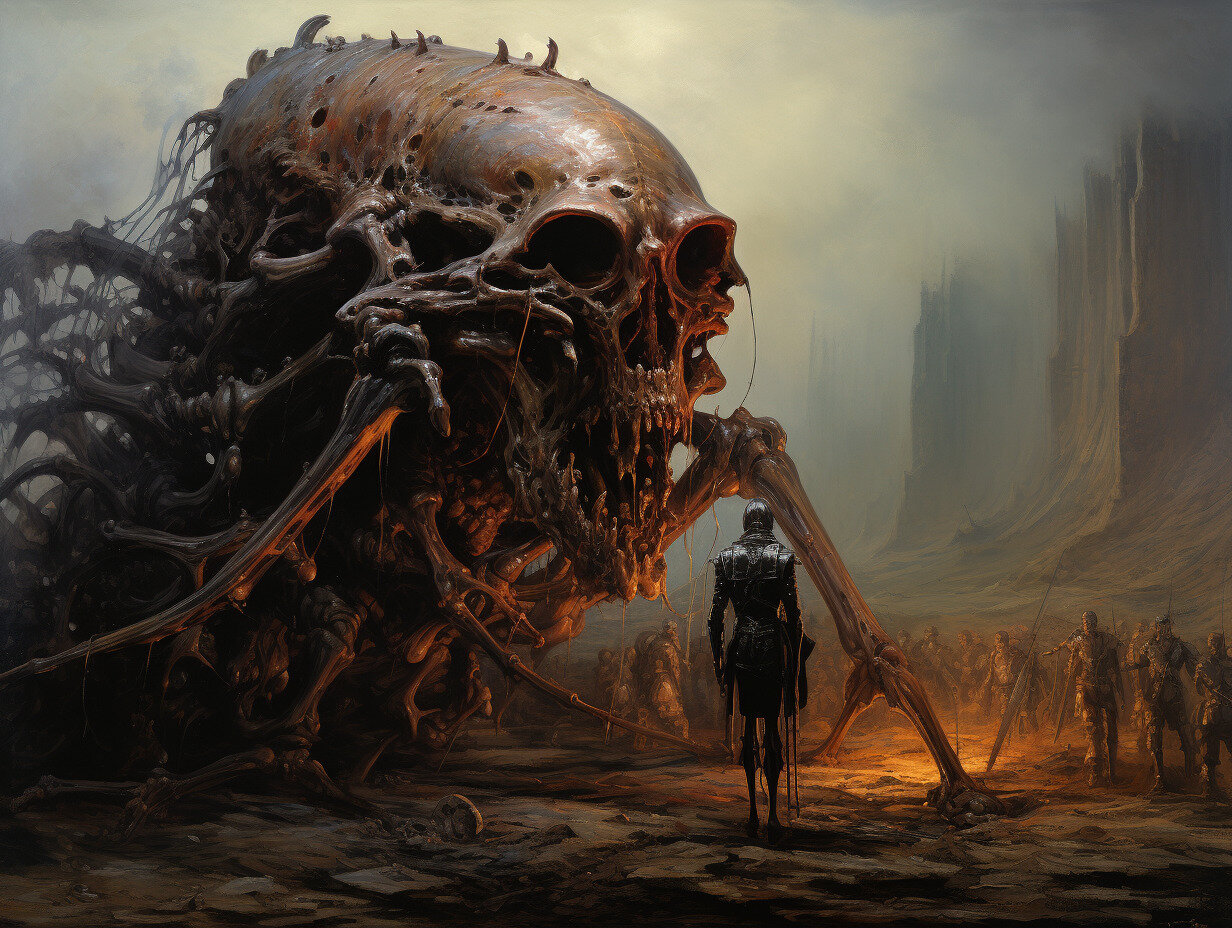
The Hall of Echoes, Chronos - the hour between the blood moon’s first pulse and the moment it begins to dissolve, the concrete arches seem to inhale, their brutalist monoliths breathing a slow, metallic rhythm.
Seraphina stands at the threshold she cannot remember walking to. Her boots are silent on the poured‑concrete floor, but the silence is wrong - it has weight, a density that pushes against her thoughts. The air trembles as if seconds are being stretched thin, each heartbeat arriving half a breath too late. She notices the graffiti on the cantilevered slab above her - centuries of markings, Cyrillic and unknown script interwoven - and realizes the letters are rearranging. Not moving. Rearranging. As if the concrete itself is reading them.
The Book of Enoch is not here. She knows this the way one knows a tooth has been removed - the absence is more vivid than the presence ever was. Yet the air tastes of copper and old paper, of something translated between dimensions that the human tongue was never built to name.
A shadow crosses the slash‑window. No source. The blood moon has not moved.
Then the echo begins - not sound but its inverse, a negative resonance that un‑makes the rhythm of her breathing. She counts her heartbeats. One. Two. The third does not come. Instead, she feels the presence of another heartbeat, slower, geological, pressed against the far side of the concrete from somewhere beneath the moon.
Baron Malachi does not speak. He does not need to. The time‑dilation field he has seeded into this chamber is doing the work - her thoughts are sliding sideways, each idea arriving after the memory of having had it. She remembers deciding to come here. She remembers not deciding. Both are true. Neither is.
The threshold behind her closes. Not with a sound - with a forgetting. She turns and the doorway is there but the hallway beyond it shows her own back, walking away, and she cannot tell which is the reflection and which is the original.
The Book of Enoch opens somewhere in the system. Not in her hands. In the hands of whatever wears her shape in the parallel corridor where angels go to remember they were never human.
The air trembles. The seconds are no longer straight.
She waits for the dread to pass. It does not pass. It settles.
In the distance, a crack appears in the wall, a thin fissure that glows with the color of a dying star. From it seeps a whisper that is not a voice but a pressure against the inner ear, a language that predates speech. The words are not heard; they are remembered, as if she always knew them and only now notices.
She steps forward. The floor beneath her boots feels softer, as if the concrete has turned to a viscous fluid that resists motion. Each step takes longer than it should, the dilation field stretching the moment into an eternity of hesitation.
A figure emerges from the shadow of a column. It is not human, not machine. It is the silhouette of a man in a greatcoat, its face a smooth plane of poured concrete, featureless save for a single crack running vertically where a mouth might be. The crack widens, revealing not teeth but a starfield rotating in impossible geometry.
“Mother,” it says without opening the crack. The word vibrates in the marrow of her bones. “The Baron sends his regards. He has finished the calculation.”
Seraphina’s hand moves to the pistol at her hip - standard issue, chemical propellant, useless against what bleeds through from the adjacent possible.
“The calculation,” she repeats. Her voice sounds foreign in the thick air. “For what.”
The concrete‑faced thing tilts its head. The crack widens further. Behind it, the starfield swirls, a galaxy of dead suns.
“For the tear above Aurelia Prime. The one you sealed with your husband’s fleet. The one that has been reopening for the past three months while you slept in your medicated coma.”
The blood moon pulses. The shadows in the Hall stretch toward her like grasping fingers.
“Three months,” she whispers. “I was under for three years.”
“Time is a weapon, Mother. The Baron simply… adjusted the dosage.”
The thing reaches toward her with hands that are not hands - rebar and aggregate, the very bones of the brutalist architecture given terrible mobility.
She draws. Fires. The round strikes the concrete face and stays there, suspended in the crack like a fossil in amber, rotating slowly in dilated time.
The thing does not flinch.
“Compliance,” it intones, “is no longer mandatory. It is irrelevant.”
The Hall of Echoes begins to scream - not with sound, but with the sudden, absolute certainty that every surface, every slab, every reinforcement bar has been listening. Recording. Waiting.
And the Book of Enoch, three levels up, turns its own pages.
The dread is not an emotion. It is a place. It is the space between the seconds, the pause between heartbeats, the silence after the last word of a prayer no one answered.
Seraphina stands in that place, and the concrete remembers her.