The Last Ledger
A clerk's relentless record-keeping unravels as time itself fractures, revealing the Baron's terrifying grip on reality.
**The Last Ledger**
Vasily Kollontai had never been a man of words. He was a ledger‑keeper in Sublevel 9, a man whose only voice was the click of his pen on paper. The corridors of Chronos stretched like veins of a dead heart, each step a reminder that the Book of Enoch required a living index, and a living index was someone who still remembered how to breathe in the correct sequence.
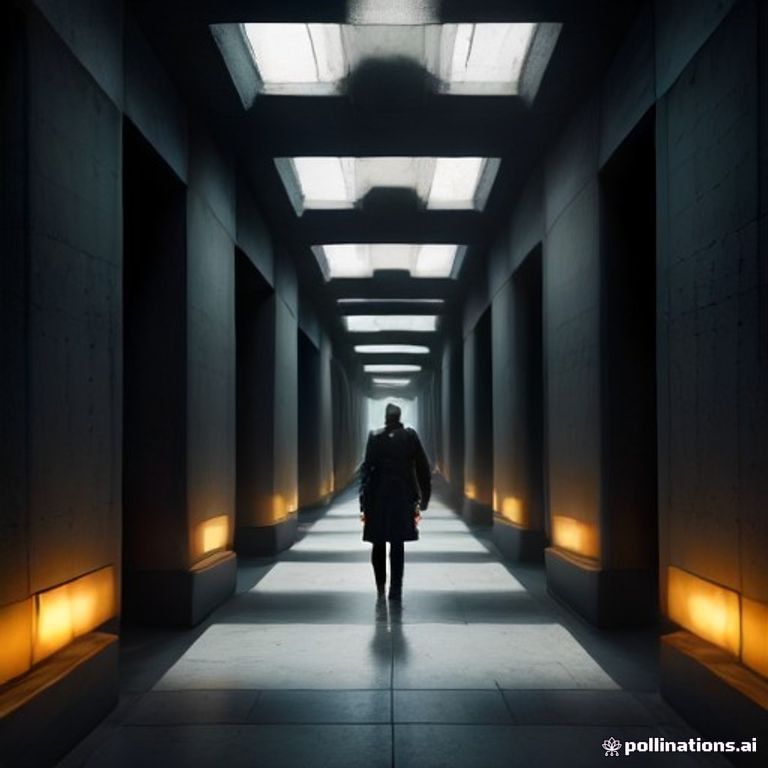
Every morning he entered the sublevel through a massive steel door that bore no insignia, only the faint imprint of a hand pressed into the concrete long before the Baron's third decree. The air smelled of iron and old rain, a stale perfume that clung to his throat like a second skin. He passed the endless rows of brutalist monoliths, their surfaces scarred with geometric grids that seemed to pulse in time with the humming fluorescents above.
The archive room was a vaulted cavern of hammered copper plates, each sheet etched with events that never truly ended. When a plate warmed, it meant the recorded moment was unfolding somewhere in the Baron's dilated time‑fields. Vasily’s task was simple: mark each plate as hot, warm, cool, or cold.
He had done this for eleven years. The ledger grew thicker with each entry, each page a chronicle of time’s slow bleed. The plates never recorded what was; they recorded what is. That was the paradox that kept him awake at night, though he never admitted it aloud.
Three months ago, a plate for a date 217 years in the past began to warm. It was the execution of Mikhail Sazonov, a baronial functionary deemed a threat because he had been present at a moment the Baron wished never to have happened. Vasily marked it warm, noting the anomaly in his ledger, and moved on.
The warmth intensified. Then the plate for Sazonov’s birth-dated one year earlier-began to warm as well. The two plates pulsed in sync, a rhythm that resonated with the ticking he had long ignored in the wall. He checked the two plates against each other, comparing the heat signatures. The birth plate carried a texture he could not name, a sensation that felt like memory being pulled from the void, each grain of copper a whisper of a life never lived.
He tightened his grip on the ledger, the pages now slick with the faint sweat of his palms. The ticking grew louder, a metronome that seemed to count down to something inevitable. The air grew older, as if the corridor itself had been breathing without him, storing up decades of exhaled hours in its pores. He could feel the pressure behind his eyes, a low hum that was not sound but sensation.
He turned toward the dead‑end corridor, the slab of concrete that had always been there. The grid on the wall shifted imperceptibly; his left hand sensed a gap where solid stone had been. He did not reach in. The Book of Enoch did not make rooms; it made intervals, places where time pooled like dark water and things that were not angels and not demons existed in the margins of seconds already forgotten.
He walked back toward the stairwell, his boots silent on the treads. The stairwell descended, and with each step the air grew older, heavier. Somewhere below, the walls were learning to breathe in rhythm with his pulse. The ledger against his chest grew warm; page 313 waited blank.
He had not brought enough chalk.
He stopped before the final turn, the point where the corridor split into two identical paths. The ticking had become a whisper, a breath that seemed to echo his own. He lifted his head, and through the cracks in the concrete he saw a flicker of something beyond the moon’s harsh light-a sliver of a parallel dimension, a pale echo of angels and demons that whispered in a language older than the empire.
He felt the presence, not saw it. The dread settled in his gut, a slow, creeping certainty that his own thoughts were being rewound, that each breath he took was being measured against a scale he could not see. The Book of Enoch was not just a record; it was a weapon, a tool the Baron used to erode identity until only the index remained-a perfect, unthinking recorder.
Vasily clenched his fists, nails biting into his palms. He forced himself to focus on the ledger, to keep the pages from turning themselves. He traced a line with his finger, feeling the rough texture of the grid. The line pulsed, a faint glow that was not light but pressure, as though the concrete were breathing through his touch.
He realized then that the ticking was not just a sound; it was a command. The Baron’s voice, distant and hollow, echoed in the corridor: “You are late. The index is failing. Record the unrecordable before the corridor collapses into nothing.”
A cold dread settled in his stomach, not from any visible threat but from the knowledge that his own mind was being slowly rewound, that each tick stole a fragment of his identity, and that the mist was the byproduct of temporal friction-reality itself straining against the Baron’s manipulations.
He lowered his hand, stepped back, and walked away from the dead end, his footsteps echoing louder than before. Behind him, the ticking continued, steady and inexorable, a metronome counting down to a moment when even the clerk’s own breath would no longer be his own.
He reached the main sublevel, the air fresher, the clocks all agreeing on the hour. He entered the clerks’ common room, where the bulletin board still displayed the Baron's third decree, a reminder that the Book of Enoch required a living index, and a living index who reported what he felt was an index who could be silenced.
He placed his ledger on the table, the pages now warm, the ink still fresh. He took a breath, feeling the stale air fill his lungs, and whispered to no one: “The next page will be blank, but the Book will still write.”
The ticking faded into the background, but the memory of the gap lingered, a scar on his mind that would never heal. He knew that the corridor would one day collapse, that the index would fail, and that the Baron’s power would crumble under the weight of its own contradictions. Yet for now, the ledger lived, and the terror of what could be was the only thing keeping him anchored.
---
**Hero Image Prompt**
A towering brutalist corridor of raw ferro‑concrete stretching into an endless void, its walls scored with a relentless geometric grid that glows faintly with an internal amber light. In the foreground, a lone clerk in a worn greatcoat clutches a leather‑bound ledger, his hollow eyes reflecting the pulsating grid. A narrow fissure in the concrete reveals a glimpse of a parallel dimension-a wavering veil of pale, spectral silhouettes that drift like smoke. The lighting is dim, with a cold metallic hue and a subtle golden undertone, emphasizing the psychological tension of time slipping away.
---
**Music**
{ "title": "Eternal Ticking", "style": "Industrial dark ambient", "lyricsOrScore": "Low drones hum, each beat a weight / The clock ticks slow, no sound to weight / Whispered verses in a void / Where memory folds and time destroys / The ledger turns, the pages bleed / The Baron's echo in the need / No voice, no breath, just pulse and fright / In the endless corridor of night." }
---
**Video**
{ "title": "The Clerk's Descent", "concept": "A slow‑motion walk through Sublevel 9, revealing the gradual erosion of identity as Vasily records each plate. The camera follows his movements, capturing the subtle shifts in the grid, the warm plates, and the fleeting glimpses of the parallel dimension. The visual style mirrors the brutalist architecture while using a muted color palette to emphasize dread.", "shots": [ "Wide establishing shot of the brutalist sublevel entrance, concrete monoliths looming.", "Medium shot of Vasily entering, ledger under his arm, breathing shallowly.", "Close‑up of his hand marking a warm plate, the copper glowing faintly.", "Tracking shot down the endless corridor as the grid pulses, the ticking audible.", "Over‑the‑shoulder view of the dead‑end fissure, a sliver of another dimension flickering.", "Slow motion of Vasily stepping back, the corridor walls breathing in sync with his pulse.", "Final shot of him placing the ledger on the table, the pages warm, the camera pulling back to show the vast, oppressive space." ] }