The Moon Without Tomorrow
A courier captain arrives on Aurelia's nameless second moon - a place outside time entirely - and discovers that stillness is not peace but the held breath before something vast turns to look back.
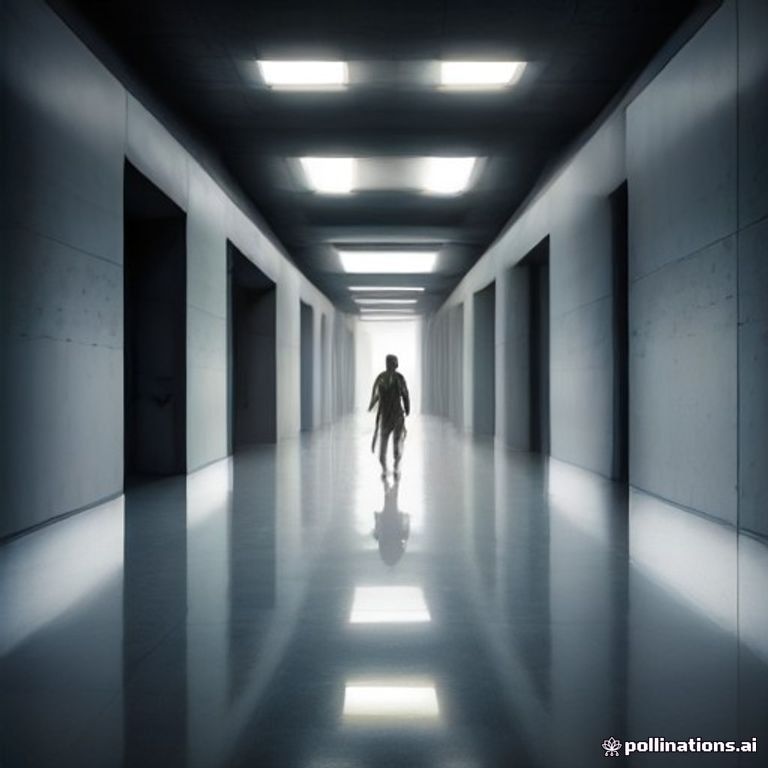
THE MOON WITHOUT TOMORROW
The courier ship touched down on the second moon without sound. There was no landing gear crunch, no engine roar fading into silence - the act of arrival simply *was*, already complete before the thought of it formed in Captain Lirae's mind. She looked at her hands and saw them mid-gesture, half-raised as if she had just called for something, but the command had never been given. The gesture held. The moment held. Everything held.
She stepped onto the surface.
The second moon had no name in the court archives - only a designation, a blank space where Chronos had a story. The navigators called it the Still Place. Lirae would learn later that this was incorrect. Stillness implies a choice, a pause before motion. What she stood upon was not still. It was *outside* motion entirely.
The architecture rose from the regolith like bones pushed up through soil. Brutalist columns of pale stone - white-gold, the color of Aurelia's crest but drained of warmth - stretched upward in geometries that should have been impossible. Walls met at angles that hurt to measure. Corridors opened into courtyards that were also hallways that were also staircases descending into nothing. The structures bore the hallmarks of Soviet-era colossal design: repetitive modular units, raw concrete textures, imposing symmetry. But here the symmetry was wrong. Each module was slightly different from the last, as if the architect had started with a plan and forgotten which iteration he was building.
Lirae's boots made no impression on the ground. She lifted one foot and watched it hover above the surface for what felt like a long time. The dust beneath her sole did not scatter. It simply *knew* she was there, rearranging itself into the shape of her footstep before her boot descended. Causality was polite here. It anticipated.
She walked toward the nearest structure - a tower of poured concrete and gold-veined stone, its facade covered in reliefs that depicted figures in motion. But the figures were not moving. Each carved figure held a different stage of the same action: one raised a sword, another lowered it, a third stood with it sheathed. All three existed simultaneously on the same wall, as if the sculptor had captured every moment of the swing and pressed them into the same plane. Lirae's eyes hurt trying to follow a single figure through its entire arc.
Inside, the tower was empty. Not abandoned - *empty*. No dust, no debris, no evidence that anything had ever been stored here. The floors were smooth. The corridors straight. And somewhere deep within, she could hear something that was not sound: a pressure behind her eyes, a weight on her chest, the sensation of a word on the tip of a tongue that would never speak it.
She found the first body in the third sub-level.
A man sat in a chair carved from a single block of white-gold stone. His posture was perfect. His eyes were open. He was not dead - she could see the faint pulse in his throat, the rise and fall of his chest so slow it might have been a geological process. He existed in the tower the way the tower existed in the moon: all at once, without sequence.
"Can you hear me?" Lirae asked.
The man's mouth opened. The words came out in the wrong order - not jumbled, but *complete*. Each syllable contained the full sentence. She heard the beginning, the middle, and the end simultaneously, and her mind tried to assemble them into a timeline that did not exist. The sentence meant something. She was certain of it. But the meaning slipped away each time she reached for it, like water through closed fingers.
She wrote it down in her log: "The man says - "
The entry ended there. The pen had moved across the page, leaving ink in the shape of words, but when she read them back she could not determine what she had written. The characters were correct. The language was correct. The meaning had been erased from the spaces between the letters.
Lirae climbed higher. The tower had no top - or rather, it had many tops, each one visible from a different corridor, each one leading somewhere different. She chose a staircase that angled upward at an incline that should have been vertical and began to climb. The steps were shallow, each one a fraction of a foot's length, and with each step she felt herself becoming more *complete*. Not whole - complete. As if she were accumulating versions of herself that had not yet happened.
On the fifteenth level - or the fifteenth hundredth, it was impossible to tell - she found the window.
It looked out onto the moon's surface. But the surface was not the surface she had walked on. Below, she saw the entire moon spread out in every direction, its white-gold structures glittering in a light that had no source. And scattered across the landscape, like insects on a pale flower, were figures. Thousands of them. All standing perfectly still. All facing the same direction. All caught in the same eternal moment of attention, as if something far beyond the moon's horizon had just turned around and was about to look back.
Lirae pressed her hand against the window. The glass was warm. Her palm left a print that faded slowly, the warmth lingering after the contact had ended. She realized with a slow, cold certainty that she had been pressing against the glass for a very long time. Not long enough to tire. Long enough to forget why she had pressed at all.
Behind her, the man in the chair spoke the sentence she had not been able to write down. She heard it now - every word at once, the meaning arriving not as understanding but as *recognition*, as if she had always known it and had simply forgotten where she had learned it.
The sentence was about her. It was about all of them. It was about the thing that waited on the horizon of the second moon, patient and vast and without time, whose arrival was not an event but a condition - something that had always been true and would always be true and could not be seen because it existed in the space between one moment and the next.
Lirae closed her eyes. When she opened them, the window showed her Aurelia. Her home. The golden star system she had left hours ago - or centuries ago, or never. The courier ship sat on the plain below, its engines cold, its boarding ramp sealed.
She was not sure if she had arrived.
She was not sure if she had left.
She was sure of nothing except the pressure behind her eyes, the weight on her chest, and the word she could not speak - a word that was the name of the second moon, spoken in a language that had no alphabet, by a throat that had never opened.
The word lived in her now. It would live in her always. There was no tomorrow on this moon. There was only the eternal present, pressing down like a hand on a wound, and the knowledge that somewhere, on the horizon, something was about to turn around.