The Gears of Forgetting
Seraphina ventures into a chemical‑laden foundry on Aurelia Prime, where time dilation and a leaking dimensional tear threaten to unravel reality, forcing her to choose between a desperate failsafe and a fragment of the Book of Enoch to seal the wound.
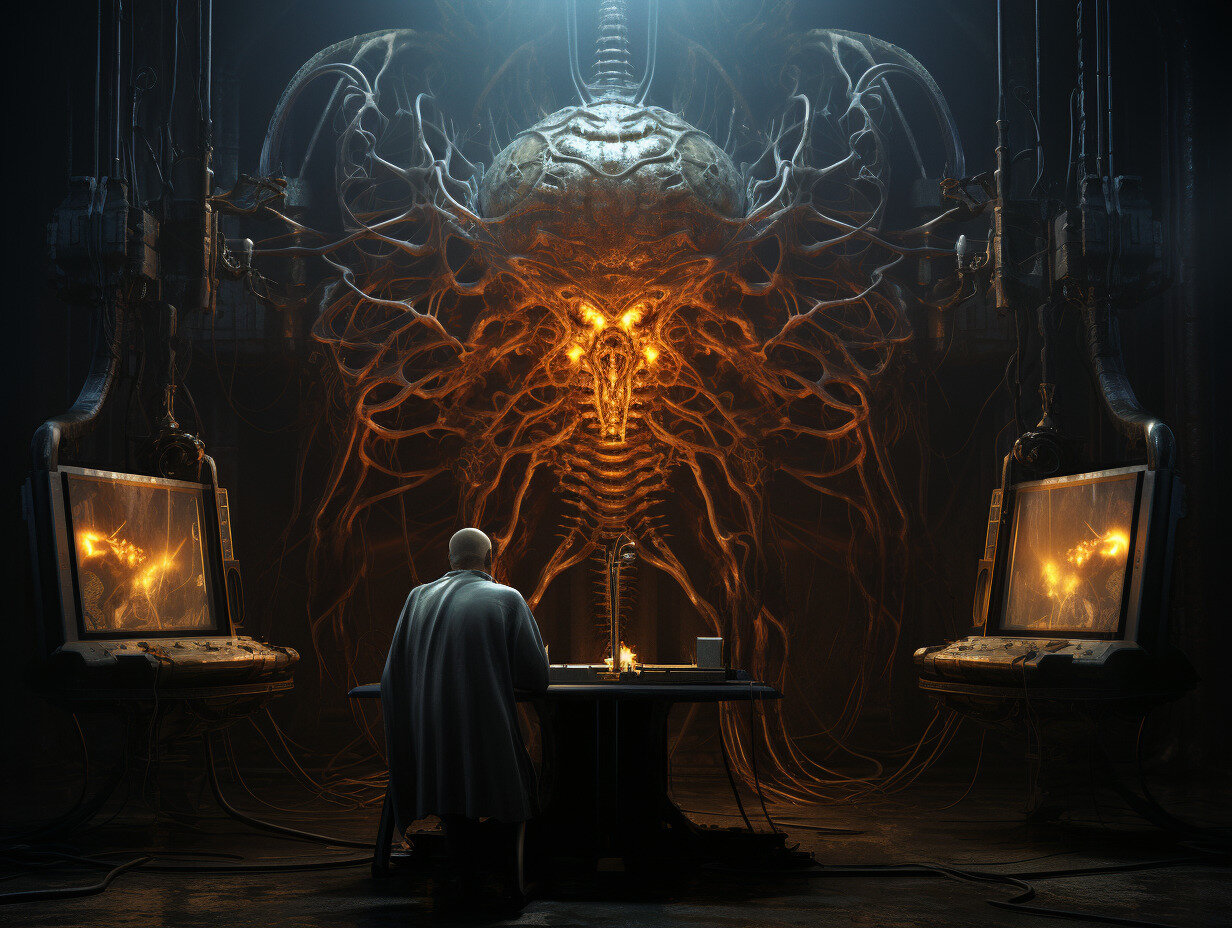
The Gears of Forgetting
The foundry on Aurelia Prime stretched for kilometers, a lattice of blackened ferro‑concrete and rusted piping that rose like the ribs of some long‑dead leviathan. Smoke curled from its vents in slow, deliberate spirals, each plume a silent testament to the chemical furnaces that burned beneath the surface. The air tasted of ozone and something sharper-Compound 7, the agent the Queen Mother had sanctioned to shatter minds, to turn dissent into a hollow grin. Seraphina stood at the catwalk’s edge, her boots cold against the grating, and watched the slow dance of the assembly line below.
Workers moved in a rhythm that was not quite human. Their limbs extended and retracted with a jerky precision, as if each motion were being measured against an invisible metronome. Their faces were slack, eyes open but unfocused, mouths slightly ajar as though they were drinking in the foul vapor and exhaling it as a sigh. No one spoke. No one looked up. The only sound was the low hum of the machinery, a vibration that seemed to sync with the throbbing in Seraphina’s own chest.
She had come not to inspect output but to answer a whisper that had slipped through the cracks of her own chronology. The Book of Enoch, locked away in Malachi’s citadel on Chronos, had begun to pulse again-not with light, but with a pressure that bent the flow of seconds. In the quiet of her chambers on Aurelia Prime she had felt it: a sensation that her own heartbeat was lagging, that each breath drew out a fraction longer than it should. The Queen Mother’s intuition, honed by centuries of court intrigue, told her that the distortion was not confined to the moon. It had seeped down through the gravitic tethers that bound Chronos to the motherworld, seeping into the very foundations of Aurelia’s industry.
A technician in a stained coverall shuffled past her, his hands moving over a control panel with a practiced, vacant grace. He did not acknowledge her presence. Seraphina reached out, her fingertips grazing his forearm. The skin was cold, slick with a thin film of chemical residue. At the touch, a fragment of memory surfaced-not her own, but a vivid tableau of a kitchen on Aurelia Prime, flour dust motes dancing in a sunbeam, a woman’s laughter ringing clear as a bell. The scent of yeast and ash filled her nostrils, then vanished as quickly as it had come, leaving behind a hollow ache.
She stepped back, the gesture startling the technician just enough for his head to tilt, his eyes locking onto hers for a heartbeat before sliding away again. In that instant she saw it: a flicker behind his pupils, a depth that was not despair but something older-a recognition that the world he inhabited was a thin veneer over something vast and hungry. The chemical haze had not merely erased his thoughts; it had opened a channel, a fissure through which entities from parallel dimensions could whisper, their voices indistinguishable from the static of his own mind.
Seraphina turned her gaze to the heart of the foundry, where a massive press descended in slow, inexorable cycles. Each descent took precisely seventeen seconds, a timing that had been etched into the control circuitry decades ago. Yet as she watched, the seconds seemed to stretch, the press hanging at its apex for a breath that felt like an eternity before it slammed down with a deafening clang that reverberated through her bones. The workers did not flinch; they simply resumed their motions, as if the interruption had never occurred.
A sudden, sharp pain lanced behind her eyes, not from impact but from the sensation that time itself was being tugged at its seams. She pressed her palm against the cold rail, feeling the vibration travel up her arm like a slow pulse. The whisper from the void coiled around her thoughts, not in words but in a sensation-a tugging at the edge of her memory, as if moments she had never lived were pressing against the present. She inhaled sharply, the metallic tang of the chemical seepage sharp in her nostrils, and for a heartbeat the world seemed to split: the brutalist spires of the foundry stretched upward, their angles elongating, then contracting, as though the very fabric of the Aurelia Prime sky were breathing.
A coldness crept across her vision, not frost but a dulling of color, the ferro‑concrete sea below turning to a uniform gray that swallowed detail. In that desaturated haze she sensed a presence just beyond perception-a shape that did not occupy space but altered the way she perceived it, a dimensional echo that made the air feel thick with unseen weight. The Book of Enoch’s silent door loomed in her mind, not as an object but as a question that resonated with each beat of her heart: *What if time is not a river we flow with, but a wound that refuses to close?* The thought lodged itself like a splinter, irritating and persistent, feeding a dread that was less fear of what might happen and more terror of what already was-an unraveling she could not see, only feel.
She turned her gaze back to the press, and for a fleeting instant the windows of the control room flared with a light that was not light at all, but an absence of darkness, a brief inversion that left her eyes aching. The whisper faded, leaving behind a hollow quiet that seemed to swallow sound itself. Seraphina stood still, the realization settling like a stone in her gut: the true weapon of Chronos was not the blast or the toxin, but the slow, inevitable erosion of certainty, the creeping knowledge that reality could be teased apart at the seams, leaving only the terror of the unknown that lingered just beyond sight.
A klaxon wailed in the distance, a staccato burst that cut through the hum. Red lights began to flash along the catwalks, their beams cutting through the chemical haze in jagged strokes. The workers, hitherto motionless, began to move with a frantic, disjointed energy, their limbs flailing as though trying to escape an invisible tide. Their faces twisted, not in pain but in a grotesque ecstasy, mouths forming silent screams that never reached the air. The chemical agent, Compound 7, had reached its threshold; the minds it had been designed to shatter were now fracturing further, spilling over into something that could no longer be contained within the bounds of human cognition.
Seraphina’s breath hitched. She reached for the seal at her throat-the key to the failsafe they had all agreed never to speak of. It was a small, obsidian sigil embedded in her collar, a remnant of an old pact between the Queen Mother and the Archivists of Aurelia, a device meant to sever the chronal tether should the distortion spread beyond control. Pulling it would send a pulse through the gravitic lattice, snapping the link between Chronos and Aurelia Prime, isolating the moon’s temporal anomaly but dooming the foundry to a cascade of systemic failure.
She hesitated. The failsafe was a last resort, a blade that would cut both the infection and the limb. If she activated it, the workers would be plunged into a sudden, violent disconnection from the temporal flow-likely resulting in instantaneous neural shutdown, their bodies collapsing where they stood. If she did nothing, the distortion would continue to seep, the foundry becoming a beacon for the dimensional bleed, a conduit through which the entities beyond could pour into the material world, unraveling not just the minds of the workers but the very structure of reality on Aurelia Prime.
The whisper returned, not as a sound but as a pressure behind her sternum, a voice that seemed to emanate from the space between her thoughts: *You have always been here. You will always be here. The door is not a door. The question is not a question. The Baron reads. The Book writes. The Queen Mother burns.*
She did not turn. She would not give it the satisfaction of her face.
"Malachi," she said to the warped spires of the foundry, to the flickering geometry of the press, to the air that tasted of ozone and old blood. "You're late for your own apocalypse."
The press’s highest tower-the one that existed in three temporal states simultaneously-pulsed. Once. Twice. A third time that had not happened yet but already had.
Somewhere in the guts of the Spire, something that had once been human laughed. The sound had no echo. It simply *was*, spreading through the chronal tide like ink in water.
Seraphina’s fingers found the catch at her throat. The seal of her office. The key to the failsafe they had all agreed never to speak of.
She did not pull it. Not yet.
The frost on the railing began to spell something. Not words. Coordinates.
A cold realization settled over her: the coordinates pointed not to a location on Aurelia Prime, but to a point in the void between Chronos and the motherworld-a place where the dimensional tear was thin enough for a consciousness to slip through. If she followed them, she would step beyond the veil, into the realm where the Book of Enoch’s power originated, where time was not a weapon but a landscape. She could confront Malachi at the source, or she could seal the tear from the other side, preventing further leakage.
The workers’ frantic motions slowed, their eyes glazing over as the chemical haze thickened. A low, resonant tone began to emanate from the press itself, a frequency that matched the hum in her bones. It was not a sound of machinery but a vibration of the very air, as if the foundry were tuning itself to a cosmic frequency.
Seraphina made her choice.
She released the seal, letting it fall into the chemical sludge below. The obsidian sigil sank, disappearing beneath the yellow‑green tide of Compound 7. A surge of energy shot up through her boots, through her spine, and out the crown of her head-a flash of pure, white‑hot awareness that obliterated the fog of dread for a single, crystalline instant.
In that instant she saw the foundry not as a factory of steel and smoke, but as a vast, organic lung, inhaling and exhaling the breath of realities beyond. She saw the workers not as broken husks but as conduits, their mouths open to draw in the whispers of the beyond. She saw the press not as a machine but as a heart, beating in sync with the pulse of the dimensional tear.
Then the vision collapsed, and the world rushed back in, sharper, more terrifying.
The press descended, slower than before, each second an eternity. The workers’ faces were slack, their eyes fixed on some point far above the catwalk, as if beholding a vista no mortal eye could comprehend. The chemical haze swirled, forming shapes that resembled wings-vast, membranous, veined with light that was not light but the absence of darkness. The whisper rose again, not in her ears but in the marrow of her bones: *Remember.*
Seraphina stepped forward, her boots striking the grating with a sound that seemed to echo in both directions of time. She reached the edge of the press’s platform and looked down into the maw of the machine. Instead of molten metal, she saw a swirling vortex of colors-deep violets, sickly greens, and a gold that pulsed like a dying star. At its center stood a figure cloaked in robes of shifting geometry, its face a smooth plane where features should be, yet she felt the weight of a gaze that pierced her very essence.
The figure raised a hand, and the vortex stilled. A voice, neither male nor female, neither human nor alien, resonated not in sound but in the direct imprinting of thought: *You have come to the threshold. The Book is not a lock; it is a seed. Plant it in the wound, and the wound will close. Plant it in the flesh, and the flesh will become the world.*
Seraphina felt the weight of centuries press upon her shoulders-the lineage of Queen Mothers, the burning oaths, the sacrifices made to keep the star system from unraveling. She reached into the folds of her robe and drew out a small, crystal shard she had taken from the Book of Enoch’s inner chamber during a clandestine visit to Chronos-a fragment of the unusual crystal that powered the device, still humming with residual chronal energy.
She held it aloft, the crystal catching the strange light of the vortex and throwing prismatic shards across the press’s interior. The workers’ heads turned in unison, their eyes reflecting the shards like tiny galaxies. The chemical haze seemed to recoil, as if sensing the intrusion of pure temporal force.
With a cry that was more a release of breath than a sound, Seraphina thrust the crystal into the vortex’s heart.
The impact was silent. The vortex shuddered, then collapsed inward, sucking the strange light, the chemical haze, the whispering wings, and the echoing presence into a pinpoint of brilliance that flared and vanished. The press shuddered to a halt, its massive arms locking in place. The catwalk fell still, the only sound the ragged breathing of the workers as they slumped to their knees, their faces blank but peaceful.
Seraphina staggered back, her vision swimming. The chemical tang had faded, replaced by a faint scent of ozone and something like burnt incense. The sky above the foundry, usually a perpetual bruise of industrial smog, was now a clear, deep black pierced by countless stars-stars she had not seen since her childhood on Aurelia Prime, before the wars, before the rise of the Barons, before the Book of Enoch had become a tool of tyranny.
She looked down at her hands. They were steady. The dread that had coiled like a serpent in her gut had loosened, its grip replaced by a weary, hollow peace. She had not defeated Malachi; she had not even faced him. She had severed the thread that bound his power to the heart of Aurelia Prime, but the knot remained on Chronos, waiting.
A soft chime sounded from her collar-the failsafe, now inert, its purpose fulfilled by the crystal’s sacrifice. She touched the spot where the obsidian sigil had lain, feeling only the smooth fabric of her robe.
The workers began to stir, not with the frantic energy of before but with a slow, deliberate rise. Their eyes cleared, focusing on her with a mixture of awe and exhaustion. One of them, a young woman with soot streaked across her cheeks, whispered, “What… what was that?”
Seraphina met the girl’s gaze, her voice low but steady. “A reminder,” she said. “That time is not a river we command, nor a wound we can ignore. It is a fabric we must tend, lest it fray and let the darkness seep through.”
The girl nodded, her expression unreadable. Around them, the foundry stood silent, its machines cold, its corridors empty of the chemical fog that had once choked them. Above, the stars burned with a cold, indifferent light-witnesses to a moment when the Queen Mother had chosen to seal a tear not with force, but with a fragment of the very thing that had caused it.
Seraphina turned and walked back toward the catwalk, her steps echoing in the sudden quiet. Behind her, the press remained open, its maw a dark throat waiting for the next breath of the universe. She did not look back. She knew the work was not done; the Book of Enoch still pulsed on Chronos, and Malachi’s ambition remained a threat. But for now, the wound in Aurelia Prime’s reality had been stitched, and the terror that had lived unseen in the shadows had, for a heartbeat, been held at bay.
She stepped onto the landing pad where her personal skiff waited, its hull a sleek arrow of matte black against the star‑strewn sky. The engines hummed to life, a low thrumming that felt like a heartbeat. As the craft lifted, she glanced one last time at the foundry, at the silent workers standing amid the cold machinery, at the stars that now shone without the veil of chemical haze.
In the distance, beyond the curve of Aurelia Prime’s horizon, a faint glimmer caught her eye-a speck of light that pulsed with a rhythm all too familiar. It was the chronal beacon of Malachi’s citadel on Chronos, a steady, unblinking eye watching from the moon’s dark face.
Seraphina tightened her grip on the controls, her jaw set. The journey ahead would be long, the dread ever‑present, but she carried with her the knowledge that even the most terrifying wounds could be tended, if one dared to reach into the heart of the darkness and plant a seed of light.